Filters
Question type

Study Flashcards

Methanol can be synthesized by combining carbon monoxide and hydrogen. CO(g) + 2H2(g) Methanol can be synthesized by combining carbon monoxide and hydrogen. CO(g) + 2H<sub>2</sub>(g)    CH<sub>3</sub>OH(g)  A reaction vessel contains the three gases at equilibrium with a total pressure of 1.00 atm.What will happen to the partial pressure of hydrogen if enough argon is added to raise the total pressure to 1.4 atm? A) The partial pressure of hydrogen will decrease. B) The partial pressure of hydrogen will increase. C) The partial pressure of hydrogen will be unchanged. D) K<sub>p</sub> needs to be known before a prediction can be made. E) Both K<sub>p</sub> and the temperature need to be known before a prediction can be made. CH3OH(g) A reaction vessel contains the three gases at equilibrium with a total pressure of 1.00 atm.What will happen to the partial pressure of hydrogen if enough argon is added to raise the total pressure to 1.4 atm?


A) The partial pressure of hydrogen will decrease.
B) The partial pressure of hydrogen will increase.
C) The partial pressure of hydrogen will be unchanged.
D) Kp needs to be known before a prediction can be made.
E) Both Kp and the temperature need to be known before a prediction can be made.

F) A) and B)
G) None of the above

Correct Answer

verifed

verified

Nitrogen dioxide decomposes according to the reaction 2NO2(g)  Nitrogen dioxide decomposes according to the reaction 2NO<sub>2</sub>(g)    2NO(g) + O<sub>2</sub>(g)  Where K<sub>p</sub> = 4.48  \times  10<sup>-13</sup> at 25°C.What is the value for K<sub>c</sub>? A) 1.81  \times  10<sup>-16</sup> B) 1.83  \times  10<sup>-14</sup> C) 4.48  \times  10<sup>-13</sup> D) 1.10  \times  10<sup>-11</sup> E) 1.11  \times  10<sup>-9</sup> 2NO(g) + O2(g) Where Kp = 4.48 ×\times 10-13 at 25°C.What is the value for Kc?


A) 1.81 ×\times 10-16
B) 1.83 ×\times 10-14
C) 4.48 ×\times 10-13
D) 1.10 ×\times 10-11
E) 1.11 ×\times 10-9

F) A) and B)
G) A) and C)

Correct Answer

verifed

verified

For a solution equilibrium,a change in concentration of a reactant or product does not change Kc.

A) True
B) False

Correct Answer

verifed

verified

Write the expression for Kc and Kp for the reaction PH3BCl3(s) Write the expression for K<sub>c</sub> and K<sub>p</sub> for the reaction PH<sub>3</sub>BCl<sub>3</sub>(s)    PH<sub>3</sub>(g)+ BCl<sub>3</sub>(g) PH3(g)+ BCl3(g)

Correct Answer

verifed

verified

Kc = [PH3][B...

View Answer

Nitric oxide is formed in automobile exhaust when nitrogen and oxygen in air react at high temperatures. N2(g) + O2(g) Nitric oxide is formed in automobile exhaust when nitrogen and oxygen in air react at high temperatures. N<sub>2</sub>(g) + O<sub>2</sub>(g)    2NO(g)  The equilibrium constant K<sub>p</sub> for the reaction is 0.0025 at 2127°C.If a container is charged with 8.00 atm of nitrogen and 5.00 atm of oxygen and the mixture is allowed to reach equilibrium,what will be the equilibrium partial pressure of nitrogen? A) 0.16 atm B) 0.31 atm C) 3.1 atm D) 7.7 atm E) 7.8 atm 2NO(g) The equilibrium constant Kp for the reaction is 0.0025 at 2127°C.If a container is charged with 8.00 atm of nitrogen and 5.00 atm of oxygen and the mixture is allowed to reach equilibrium,what will be the equilibrium partial pressure of nitrogen?


A) 0.16 atm
B) 0.31 atm
C) 3.1 atm
D) 7.7 atm
E) 7.8 atm

F) A) and C)
G) B) and D)

Correct Answer

verifed

verified

Which of the following has an effect on the magnitude of the equilibrium constant?


A) activation energy of the forward reaction
B) concentrations of the reactants and products
C) presence of a catalyst
D) change in volume of container
E) change in temperature

F) A) and E)
G) A) and D)

Correct Answer

verifed

verified

At 850°C,the equilibrium constant Kp for the reaction C(s) + CO2(g) At 850°C,the equilibrium constant K<sub>p</sub> for the reaction C(s) + CO<sub>2</sub>(g)    2CO(g)  Has a value of 10.7.If the total pressure in the system at equilibrium is 1.000 atm,what is the partial pressure of carbon monoxide? A) 0.362 atm B) 0.489 atm C) 0.667 atm D) 0.915 atm E) 0.921 atm 2CO(g) Has a value of 10.7.If the total pressure in the system at equilibrium is 1.000 atm,what is the partial pressure of carbon monoxide?


A) 0.362 atm
B) 0.489 atm
C) 0.667 atm
D) 0.915 atm
E) 0.921 atm

F) None of the above
G) A) and B)

Correct Answer

verifed

verified

The equilibrium constant,Kp,has a value of 6.5 ×\times 10-4 at 308 K for the reaction of nitrogen monoxide with chlorine. 2NO(g) + Cl2(g)  The equilibrium constant,K<sub>p</sub>,has a value of 6.5  \times  10<sup>-4</sup> at 308 K for the reaction of nitrogen monoxide with chlorine. 2NO(g) + Cl<sub>2</sub>(g)    2NOCl(g)  What is the value of K<sub>c</sub>? A) 2.5  \times  10<sup>-7</sup> B) 6.5  \times  10<sup>-4</sup> C) 1.6  \times  10<sup>-2</sup> D) 1.7 E) None of these choices is correct. 2NOCl(g) What is the value of Kc?


A) 2.5 ×\times 10-7
B) 6.5 ×\times 10-4
C) 1.6 ×\times 10-2
D) 1.7
E) None of these choices is correct.

F) A) and E)
G) None of the above

Correct Answer

verifed

verified

At 25°C,the equilibrium constant Kc for the reaction in the solvent CCl4 2BrCl  At 25°C,the equilibrium constant K<sub>c</sub> for the reaction in the solvent CCl<sub>4</sub> <sub> </sub>2BrCl   Br<sub>2</sub> + Cl<sub>2</sub> <sub> </sub>is 0.141.If the initial concentration of chlorine is 0.0300 M and of bromine monochloride is 0.0200 M,what is the equilibrium concentration of bromine? A) 1.35  \times  10<sup>-3</sup> M B) 2.70  \times  10<sup>-3</sup> M C) 8.82  \times  10<sup>-3</sup> M D) 9.70  \times  10<sup>-2</sup> M E) None of these choices is correct. Br2 + Cl2 is 0.141.If the initial concentration of chlorine is 0.0300 M and of bromine monochloride is 0.0200 M,what is the equilibrium concentration of bromine?


A) 1.35 ×\times 10-3 M
B) 2.70 ×\times 10-3 M
C) 8.82 ×\times 10-3 M
D) 9.70 ×\times 10-2 M
E) None of these choices is correct.

F) A) and E)
G) B) and C)

Correct Answer

verifed

verified

a.State Le Chatelier's principle b.The following reaction is at equilibrium in a closed container: a.State Le Chatelier's principle b.The following reaction is at equilibrium in a closed container:     What effects,if any,will the following actions have on the position of equilibrium? In each case,state the direction of any shift in equilibrium,and give your reasons in one sentence. (i)adding more Fe(OH)<sub>3</sub> <sub> </sub>(ii)raising the temperature (iii)adding a catalyst What effects,if any,will the following actions have on the position of equilibrium? In each case,state the direction of any shift in equilibrium,and give your reasons in one sentence. (i)adding more Fe(OH)3 (ii)raising the temperature (iii)adding a catalyst

Correct Answer

verifed

verified

a.If a stress is applied to a system at ...

View Answer

Ammonia is synthesized in the Haber process: N2(g)+ 3H2(g)  Ammonia is synthesized in the Haber process: N<sub>2</sub>(g)+ 3H<sub>2</sub>(g)    2NH<sub>3</sub>(g) K<sub>p</sub> for this reaction is 1.49  \times  10<sup>-5</sup> atm<sup>-2</sup> at 500.°C.Calculate K<sub>c</sub> at this temperature. 2NH3(g) Kp for this reaction is 1.49 ×\times 10-5 atm-2 at 500.°C.Calculate Kc at this temperature.

Correct Answer

verifed

verified

Kc = 6.00...

View Answer

Although a system may be at equilibrium,the rate constants of the forward and reverse reactions will in general be different.

A) True
B) False

Correct Answer

verifed

verified

About half of the sodium carbonate produced is used in making glass products because it lowers the melting point of sand,the major component of glass.When sodium carbonate is added to water it hydrolyses according to the following reactions.  About half of the sodium carbonate produced is used in making glass products because it lowers the melting point of sand,the major component of glass.When sodium carbonate is added to water it hydrolyses according to the following reactions.   These can be combined to yield   What is the value of K<sub>3</sub>? A) K<sub>1</sub>  \times  K<sub>2</sub> B) K<sub>1</sub>  \times  K<sub>2</sub>. C) K<sub>1</sub> + K<sub>2</sub> D) K<sub>1</sub> - K<sub>2</sub> E) (K<sub>1</sub>K<sub>2</sub>) <sup>2</sup> These can be combined to yield  About half of the sodium carbonate produced is used in making glass products because it lowers the melting point of sand,the major component of glass.When sodium carbonate is added to water it hydrolyses according to the following reactions.   These can be combined to yield   What is the value of K<sub>3</sub>? A) K<sub>1</sub>  \times  K<sub>2</sub> B) K<sub>1</sub>  \times  K<sub>2</sub>. C) K<sub>1</sub> + K<sub>2</sub> D) K<sub>1</sub> - K<sub>2</sub> E) (K<sub>1</sub>K<sub>2</sub>) <sup>2</sup> What is the value of K3?


A) K1 ×\times K2
B) K1 ×\times K2.
C) K1 + K2
D) K1 - K2
E) (K1K2) 2

F) None of the above
G) A) and E)

Correct Answer

verifed

verified

Hydrogen bromide will dissociate into hydrogen and bromine gases. Hydrogen bromide will dissociate into hydrogen and bromine gases.   What effect will a temperature increase of 50°C have on this system at equilibrium? A) The partial pressure of hydrogen bromide will increase. B) The partial pressure of hydrogen will increase. C) The partial pressure of hydrogen bromide and bromine will increase. D) There will be no effect on the partial pressure of any of the gases. E) The initial pressure,volume and temperature must be known before any of the above predictions can be made. What effect will a temperature increase of 50°C have on this system at equilibrium?


A) The partial pressure of hydrogen bromide will increase.
B) The partial pressure of hydrogen will increase.
C) The partial pressure of hydrogen bromide and bromine will increase.
D) There will be no effect on the partial pressure of any of the gases.
E) The initial pressure,volume and temperature must be known before any of the above predictions can be made.

F) A) and D)
G) B) and C)

Correct Answer

verifed

verified

Compounds A,B,and C react according to the following equation. 3A(g) + 2B(g) Compounds A,B,and C react according to the following equation. 3A(g) + 2B(g)    2C(g)  At 100°C a mixture of these gases at equilibrium showed that [A] = 0.855 M,[B] = 1.23 M,and [C] = 1.75 M.What is the value of K<sub>c</sub> for this reaction? A) 0.309 B) 0.601 C) 1.66 D) 3.24 E) > 10 2C(g) At 100°C a mixture of these gases at equilibrium showed that [A] = 0.855 M,[B] = 1.23 M,and [C] = 1.75 M.What is the value of Kc for this reaction?


A) 0.309
B) 0.601
C) 1.66
D) 3.24
E) > 10

F) C) and D)
G) C) and E)

Correct Answer

verifed

verified

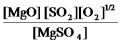
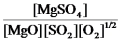
Write the mass-action expression,Qc ,for the following chemical reaction. MgO(s) + SO2(g) + Write the mass-action expression,Q<sub>c</sub> ,for the following chemical reaction. MgO(s) + SO<sub>2</sub>(g) +   O<sub>2</sub>(g)    MgSO<sub>4</sub>(s)  A)    B)    C)    D)    E) None of these expressions is correct. O2(g) Write the mass-action expression,Q<sub>c</sub> ,for the following chemical reaction. MgO(s) + SO<sub>2</sub>(g) +   O<sub>2</sub>(g)    MgSO<sub>4</sub>(s)  A)    B)    C)    D)    E) None of these expressions is correct. MgSO4(s)


A)
Write the mass-action expression,Q<sub>c</sub> ,for the following chemical reaction. MgO(s) + SO<sub>2</sub>(g) +   O<sub>2</sub>(g)    MgSO<sub>4</sub>(s)  A)    B)    C)    D)    E) None of these expressions is correct.
B)
Write the mass-action expression,Q<sub>c</sub> ,for the following chemical reaction. MgO(s) + SO<sub>2</sub>(g) +   O<sub>2</sub>(g)    MgSO<sub>4</sub>(s)  A)    B)    C)    D)    E) None of these expressions is correct.
C)
Write the mass-action expression,Q<sub>c</sub> ,for the following chemical reaction. MgO(s) + SO<sub>2</sub>(g) +   O<sub>2</sub>(g)    MgSO<sub>4</sub>(s)  A)    B)    C)    D)    E) None of these expressions is correct.
D)
Write the mass-action expression,Q<sub>c</sub> ,for the following chemical reaction. MgO(s) + SO<sub>2</sub>(g) +   O<sub>2</sub>(g)    MgSO<sub>4</sub>(s)  A)    B)    C)    D)    E) None of these expressions is correct.
E) None of these expressions is correct.

F) B) and C)
G) A) and E)

Correct Answer

verifed

verified

Consider the reactions of cadmium with the thiosulfate anion.  Consider the reactions of cadmium with the thiosulfate anion.   What is the value for the equilibrium constant for the following reaction? Cd<sup>2+</sup>(aq) + 2S<sub>2</sub>O<sub>3</sub><sup>2-</sup>(aq)    Cd(S<sub>2</sub>O<sub>3</sub>) <sub>2</sub><sup>2-</sup>(aq)  A) 0.030 B) 33 C) 8.1  \times  10<sup>3</sup> D) 8.6  \times  10<sup>3</sup> E) 2.1  \times  10<sup>6</sup> What is the value for the equilibrium constant for the following reaction? Cd2+(aq) + 2S2O32-(aq)  Consider the reactions of cadmium with the thiosulfate anion.   What is the value for the equilibrium constant for the following reaction? Cd<sup>2+</sup>(aq) + 2S<sub>2</sub>O<sub>3</sub><sup>2-</sup>(aq)    Cd(S<sub>2</sub>O<sub>3</sub>) <sub>2</sub><sup>2-</sup>(aq)  A) 0.030 B) 33 C) 8.1  \times  10<sup>3</sup> D) 8.6  \times  10<sup>3</sup> E) 2.1  \times  10<sup>6</sup> Cd(S2O3) 22-(aq)


A) 0.030
B) 33
C) 8.1 ×\times 103
D) 8.6 ×\times 103
E) 2.1 ×\times 106

F) C) and D)
G) B) and E)

Correct Answer

verifed

verified

When 0.152 mol of solid PH3BCl3 is introduced into a 3.0 L container at a certain temperature,8.44 ×\times 10-3 mol of PH3 is present at equilibrium: PH3BCl3(s)  When 0.152 mol of solid PH<sub>3</sub>BCl<sub>3</sub> is introduced into a 3.0 L container at a certain temperature,8.44  \times  10<sup>-3</sup> mol of PH<sub>3</sub> is present at equilibrium: PH<sub>3</sub>BCl<sub>3</sub>(s)    PH<sub>3</sub>(g)+ BCl<sub>3</sub>(g) Construct a reaction table for the process,and use it to calculate K<sub>c</sub> at this temperature. PH3(g)+ BCl3(g) Construct a reaction table for the process,and use it to calculate Kc at this temperature.

Correct Answer

verifed

verified

blured image Kc = (0....

View Answer

The following reaction is at equilibrium at a pressure of 1 atm,in a closed container. The following reaction is at equilibrium at a pressure of 1 atm,in a closed container.   Which,if any,of the following actions will decrease the concentration of CO<sub>2</sub> gas present at equilibrium? A) adding N<sub>2</sub> gas to double the pressure B) adding more solid NaOH C) increasing the volume of the container D) lowering the temperature E) None of these choices is correct. Which,if any,of the following actions will decrease the concentration of CO2 gas present at equilibrium?


A) adding N2 gas to double the pressure
B) adding more solid NaOH
C) increasing the volume of the container
D) lowering the temperature
E) None of these choices is correct.

F) A) and B)
G) B) and E)

Correct Answer

verifed

verified

Sodium hydrogen carbonate decomposes above 110°C to form sodium carbonate,water,and carbon dioxide. 2NaHCO3(s) Sodium hydrogen carbonate decomposes above 110°C to form sodium carbonate,water,and carbon dioxide. 2NaHCO<sub>3</sub>(s)    Na<sub>2</sub>CO<sub>3</sub>(s) + H<sub>2</sub>O(g) + CO<sub>2</sub>(g)  One thousand grams of sodium hydrogen carbonate are added to a reaction vessel,the temperature is increased to 200°C,and the system comes to equilibrium.What happens in this system if another 50 g of sodium carbonate are now added? A) The partial pressure of carbon dioxide will increase. B) The partial pressure of carbon dioxide will decrease. C) The partial pressure of carbon dioxide will be unchanged. D) The amounts of all products will be greater when equilibrium is reestablished. E) None of these conclusions is justified without knowing the equilibrium constant. Na2CO3(s) + H2O(g) + CO2(g) One thousand grams of sodium hydrogen carbonate are added to a reaction vessel,the temperature is increased to 200°C,and the system comes to equilibrium.What happens in this system if another 50 g of sodium carbonate are now added?


A) The partial pressure of carbon dioxide will increase.
B) The partial pressure of carbon dioxide will decrease.
C) The partial pressure of carbon dioxide will be unchanged.
D) The amounts of all products will be greater when equilibrium is reestablished.
E) None of these conclusions is justified without knowing the equilibrium constant.

F) A) and B)
G) A) and C)

Correct Answer

verifed

verified

Showing 21 - 40 of 85

Related Exams

Show Answer