A) ADP and phosphate.
B) FAD and NAD+.
C) FAD and NADPH.
D) ADP and FAD.
E) ADP and NAD+.
G) B) and D)
Correct Answer

verified
Correct Answer
verified
A) The chloroplast's electron transport system provides the ions.
B) Hydrogen ions naturally collect on the outside of the organelle membrane.
C) Hydrogen ions are pumped across the membrane by carrier proteins of the electron transport chain.
D) All of the choices establish the electrochemical gradient.
F) All of the above
Correct Answer
verified
Correct Answer
verified
A) In competitive inhibition,the inhibitor binds to the active site of the enzyme.
B) In noncompetitive inhibition,the inhibitor binds to the allosteric site of the substrate.
C) In irreversible inhibition,a poison binds to the enzyme so that it can never work again.
D) Most inhibitors act in a reversible fashion.
E) All of the statements are true.
G) None of the above
Correct Answer
verified
Correct Answer
verified
A) heating to temperatures above 100 C
B) addition of strong acids or strong bases
C) phosphorylation
D) addition of distilled water
F) A) and B)
Correct Answer
verified
Correct Answer
verified
A) 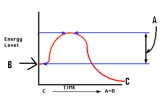
B) 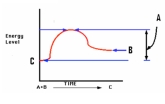
C) 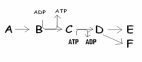
E) A) and C)
Correct Answer
verified
Correct Answer
verified
A) Energy is changed from one form to another with a loss of usable energy.
B) Energy is not created nor destroyed,but it can change from one energy form to another.
C) Energy can be created from matter or used to produce matter.
D) Some useful energy is lost as heat whenever an energy transfer occurs.
E) Energy transfers are always 100% efficient in changing energy from one useful form to another.
G) C) and D)
Correct Answer
verified
Correct Answer
verified
A) reduced; oxidized
B) oxidized; oxidized
C) reduced; reduced
D) oxidized; reduced
F) None of the above
Correct Answer
verified
D
Correct Answer
verified
A) an ionic cofactor that interacts with an enzyme to allow it to work.
B) a protein cofactor that interacts with an enzyme to allow it to work.
C) a nonprotein organic cofactor that interacts with an enzyme to allow it to work.
D) an ionic cofactor that interacts with an enzyme to inhibit it.
E) a protein cofactor that interacts with an enzyme to inhibit it.
G) A) and D)
Correct Answer
verified
Correct Answer
verified
A) glucose & oxygen
B) glucose & ATP
C) carbon dioxide & energy
D) carbon dioxide & water
F) All of the above
Correct Answer
verified
Correct Answer
verified
A) H+
B) 3H+
C) OH_
D) 2H+
F) A) and C)
Correct Answer
verified
Correct Answer
verified
B) False
Correct Answer
verified
Correct Answer
verified
A) A; E
B) B; E and F
C) A; E and F
D) A and B; D and E
F) A) and B)
Correct Answer
verified
Correct Answer
verified
A) increase in substrate concentration
B) a vitamin
C) a 2-4 degree increase in temperature
D) the presence of lead
F) All of the above
Correct Answer
verified
D
Correct Answer
verified
A) All chemicals immediately lose their high-energy bonds.
B) All molecules immediately degrade into basic elements.
C) All energy immediately leaves,and that is one manifestation that the organism is dead.
D) The chemical compounds in cells lose their organization over time because there is no longer an input of energy to maintain the organized state.
E) The chemical compounds remain exactly intact and ready to start up again unless digested by a consumer or decay organism.
G) A) and D)
Correct Answer
verified
D
Correct Answer
verified
A) NAD+
B) NAD-
C) NADP+
D) CO_
F) A) and D)
Correct Answer
verified
Correct Answer
verified
A) As our body converts glucose into ATP some of the energy is given off in the form of heat.
B) The temperature of your car's engine begins to increase as you drive to work.
C) When we are cold our body shivers as a response to the decrease in body temperature.
D) None of these are in defiance of the Second Law of Thermodynamics.
F) A) and C)
Correct Answer
verified
Correct Answer
verified
B) False
Correct Answer
verified
Correct Answer
verified
A) Golgi complexes and lysosomes.
B) Mitochondria and chloroplasts.
C) Endoplasmic reticulum and vesicles.
D) Vacuoles and vesicles.
E) Mitochondria and endoplasmic reticulum.
G) A) and B)
Correct Answer
verified
Correct Answer
verified
A) The reaction will soon stop because the amount of saliva is small,and you would have to add more saliva to continue the degradation.
B) The reaction will continue,since the enzyme is not denatured by the reaction.
C) The reaction will continue until half is digested and then stop because the reaction between substrate and product will be balanced.
D) Absolutely no degradation of the yogurt will occur naturally unless in the presence of this enzyme. In
F) B) and C)
Correct Answer
verified
Correct Answer
verified
A) food
B) water in a dam
C) a muscle contracting
D) All of the choices are not potential energy.
F) None of the above
Correct Answer
verified
Correct Answer
verified
Showing 1 - 20 of 55
Related Exams