A) profit = price - marginal cost
B) profit = price - average total cost
C) profit = (price - marginal cost) × quantity
D) profit = (price - average total cost) × quantity
F) A) and B)
Correct Answer

verified
Correct Answer
verified
A) (iii) only
B) (iii) and (iv) only
C) (i) and (ii) only
D) (i) , (ii) , (iii) , and (iv)
F) B) and C)
Correct Answer
verified
Correct Answer
verified
B) False
Correct Answer
verified
Correct Answer
verified
B) False
Correct Answer
verified
Correct Answer
verified
A) $6
B) $12
C) $18
D) $24
F) A) and C)
Correct Answer
verified
Correct Answer
verified
Correct Answer
verified
Correct Answer
verified
A) separate customers according to their willingnesses to pay.
B) differentiate between different units of its product.
C) engage in arbitrage.
D) use coupons.
F) B) and C)
Correct Answer
verified
Correct Answer
verified
B) False
Correct Answer
verified
Correct Answer
verified
A) profit-maximizing monopoly.
B) producer of externalities.
C) revenue-maximizing monopoly.
D) natural monopoly.
F) B) and D)
Correct Answer
verified
Correct Answer
verified
B) False
Correct Answer
verified
Correct Answer
verified
B) False
Correct Answer
verified
Correct Answer
verified
A) decrease the profit-maximizing price and increase the profit-maximizing quantity produced.
B) increase the profit-maximizing price and decrease the profit-maximizing quantity produced.
C) not effect the profit-maximizing price or quantity.
D) possibly increase, decrease or not effect profit-maximizing price and quantity, depending on the elasticity of demand.
F) C) and D)
Correct Answer
verified
Correct Answer
verified
A) senior-citizen laws mandate such discounts.
B) goodwill efforts earn community respect and win loyal patrons.
C) the theaters are profit maximizers.
D) senior citizens lobby city councils for lower prices.
F) None of the above
Correct Answer
verified
Correct Answer
verified
Figure 15-24 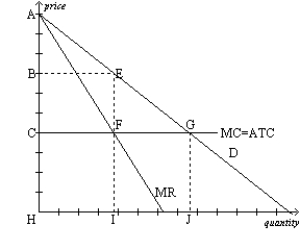
-Refer to Figure 15-24. Which letter represents the profit-maximizing price chosen by the single price monopolist?
) undefined
Correct Answer
verified
Correct Answer
verified
A) 3 units
B) 4 units
C) 5 units
D) 6 units
F) B) and C)
Correct Answer
verified
Correct Answer
verified
A) An online bookstore charges more for overnight shipping than standard shipping when customers buy books from it.
B) Airline tickets are more expensive for first-class seats than for coach.
C) Hotel rates for AAA members are lower than for nonmembers.
D) All of the above are correct.
F) A) and D)
Correct Answer
verified
Correct Answer
verified
A) 100 units of output and a price of $20 per unit
B) 150 units of output and a price of $20 per unit
C) 150 units of output and a price of $30 per unit
D) 200 units of output and a price of $20 per unit
F) C) and D)
Correct Answer
verified
Correct Answer
verified
A) stays the same.
B) increases.
C) decreases.
D) may increase or decrease depending on the price elasticity of demand.
F) C) and D)
Correct Answer
verified
Correct Answer
verified
A) equal to marginal revenue.
B) greater than the price of its product.
C) equal to the price of its product.
D) less than the price of its product.
F) A) and D)
Correct Answer
verified
Correct Answer
verified
A) help to keep prices down.
B) help to prevent a single firm from acquiring ownership of a key resource.
C) encourage creative activity.
D) discourage the production of inefficient products.
F) A) and B)
Correct Answer
verified
Correct Answer
verified
Showing 581 - 600 of 637
Related Exams