Filters
Question type

Study Flashcards

For the overall chemical reaction shown below, which one of the following statements can be rightly assumed? 2H2S(g) + O2(g) → 2S(s) + 2H2O(l)


A) The reaction is third-order overall.
B) The reaction is second-order overall.
C) The rate law is: rate = k[H2S]2 [O2].
D) The rate law is: rate = k[H2S] [O2].
E) The rate law cannot be determined from the information given.

F) A) and E)
G) B) and D)

Correct Answer

verifed

verified

The rate constant for a reaction is 4.65 L • mol-1 • s-1. What is the overall order of the reaction?


A) Zero
B) First
C) Second
D) Third
E) More information is needed to determine the overall order.

F) C) and D)
G) B) and E)

Correct Answer

verifed

verified

When the reaction A → B + C is studied, a plot 1/[A]t vs. time gives a straight line with a positive slope. What is the order of the reaction with respect to A?


A) Zero
B) First
C) Second
D) Third
E) More information is needed to determine the order.

F) A) and E)
G) B) and E)

Correct Answer

verifed

verified

A reaction intermediate is a species corresponding to a local energy maximum on a reaction energy diagram.

A) True
B) False

Correct Answer

verifed

verified

For the following reaction, ΔP(C6H14) /Δt was found to be -6.2 × 10⁻³ atm/s. C6H14(g) → C6H6(g) + 4H2(g) Determine ΔP(H2) /Δt for this reaction at the same time.


A) 6.2 × 10⁻³ atm/s
B) 1.6 × 10⁻³ atm/s
C) 2.5 × 10⁻² atm/s
D) -1.6 × 10⁻³ atm/s
E) -2.5 × 10⁻² atm/s

F) A) and B)
G) B) and D)

Correct Answer

verifed

verified

Ammonium ion (NH4+) reacts with nitrite ion (NO2-) to yield nitrogen gas and liquid water. The following initial rates of reaction have been measured for the given reactant concentrations. Ammonium ion (NH<sub>4</sub><sup>+</sup>)  reacts with nitrite ion (NO<sub>2</sub><sup>-</sup>)  to yield nitrogen gas and liquid water. The following initial rates of reaction have been measured for the given reactant concentrations.   Which of the following is the rate law (rate equation)  for this reaction? A)  rate = k [NH<sub>4</sub><sup>+</sup>] [NO<sub>2</sub><sup>-</sup>]<sup>4</sup> B)  rate = k [NH<sub>4</sub><sup>+</sup>] [NO<sub>2</sub><sup>-</sup>] C)  rate = k [NH<sub>4</sub><sup>+</sup>] [NO<sub>2</sub><sup>-</sup>]<sup>2</sup> D)  rate = k [NH<sub>4</sub><sup>+</sup>]<sup>2</sup> [NO<sub>2</sub><sup>-</sup>] E)  rate = k [NH<sub>4</sub><sup>+</sup>]<sup>1/2</sup> [NO<sub>2</sub><sup>-</sup>]<sup>1/4</sup> Which of the following is the rate law (rate equation) for this reaction?


A) rate = k [NH4+] [NO2-]4
B) rate = k [NH4+] [NO2-]
C) rate = k [NH4+] [NO2-]2
D) rate = k [NH4+]2 [NO2-]
E) rate = k [NH4+]1/2 [NO2-]1/4

F) A) and B)
G) B) and C)

Correct Answer

verifed

verified

The isomerization of methyl isocyanide, CH3NC → CH3CN, follows first-order kinetics. The half-lives were found to be 161 min at 199°C and 12.5 min at 230.°C. Calculate the activation energy for this reaction. (R = 8.314 J/mol • K)


A) 6.17 × 10⁻³ kJ/mol
B) 31.4 kJ/mol
C) 78.2 kJ/mol
D) 124 kJ/mol
E) 163 kJ/mol

F) A) and E)
G) B) and E)

Correct Answer

verifed

verified

The ________ is the equation relating the rate of the reaction to the concentration of molecule.

Correct Answer

verifed

verified

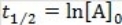
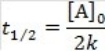
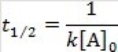
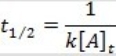
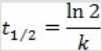
What is the half-life for a second-order reaction?


A) What is the half-life for a second-order reaction? A)    B)    C)    D)    E)
B) What is the half-life for a second-order reaction? A)    B)    C)    D)    E)
C) What is the half-life for a second-order reaction? A)    B)    C)    D)    E)
D) What is the half-life for a second-order reaction? A)    B)    C)    D)    E)
E) What is the half-life for a second-order reaction? A)    B)    C)    D)    E)

F) B) and D)
G) A) and D)

Correct Answer

verifed

verified

What is the name given to the equation that relates the rate of reaction to the concentrations of reactants?

Correct Answer

verifed

verified

The rate law for the reaction H2O2 + 2H+ + 2I- → I2 + 2H2O is rate = k[H2O2][I-]. The following mechanism has been suggested. H2O2 + I- → HOI + OH- (slow) OH- + H+ → H2O (fast) HOI + H+ + I- → I2 + H2O (fast) Identify all intermediates included in this mechanism.


A) H+and I-
B) H+ and HOI
C) HOI and OH-
D) H+only
E) H2O and OH-

F) B) and C)
G) A) and E)

Correct Answer

verifed

verified

________ describes the reaction rate as being directly proportional to the number of molecular collisions per second.

Correct Answer

verifed

verified

The following is an Arrhenius plot of a first-order reaction. The rate constant is measured in units of s-1. The following is an Arrhenius plot of a first-order reaction. The rate constant is measured in units of s<sup>-1</sup>.   Based on this Arrhenius plot, what is the activation energy of the reaction? (R = 8.314 J/K •mol)  A)  4.0 kJ/mol B)  5.0 kJ/mol C)  40 kJ/mol D)  42 kJ/mol E)  50 kJ/mol Based on this Arrhenius plot, what is the activation energy of the reaction? (R = 8.314 J/K •mol)


A) 4.0 kJ/mol
B) 5.0 kJ/mol
C) 40 kJ/mol
D) 42 kJ/mol
E) 50 kJ/mol

F) A) and E)
G) None of the above

Correct Answer

verifed

verified

For each of the following terms/concepts, give a brief explanation or definition. a. order of a reaction b. elementary reaction c. reaction intermediate

Correct Answer

verifed

verified

a. Order refers to the power to which th...

View Answer

The intermediate in a reaction appears in the mechanism of the reaction and in the overall balanced equation.

A) True
B) False

Correct Answer

verifed

verified

What statement below best describes the graph representing the integrated second-order rate law?


A) A plot of [A]t vs. t yields a straight line with a negative slope equal to -k.
B) A plot of 1/[A]t vs. t yields a straight line with a negative slope equal to k.
C) A plot of ln[A]t vs. t yields a straight line with a positive slope equal to -k.
D) A plot of ln[A]t vs. t yields a straight line with a negative slope equal to -k.
E) A plot of 1/[A]t vs. t yields a straight line with a positive slope equal to k.

F) B) and D)
G) A) and E)

Correct Answer

verifed

verified

What is the slope of a plot of ln k vs. 1/T for the Arrhenius equation k = Ae-(Ea/RT) ?


A) A
B) -k
C) -Ea/R
D) k
E) Ea

F) All of the above
G) A) and D)

Correct Answer

verifed

verified

For the chemical reaction A → B + C, a plot of [A]t versus time is found to give a straight line with a negative slope. What is the order of reaction with respect to A?


A) Zeroth
B) First
C) Second
D) Third
E) Such a plot cannot reveal the order of the reaction.

F) D) and E)
G) A) and B)

Correct Answer

verifed

verified

For a second-order reaction, if [A]-1 is plotted vs. time, which corresponds to the slope of this plot?


A) 1/[A]
B) k
C) 1/k
D) ln[A]
E) -k

F) None of the above
G) B) and E)

Correct Answer

verifed

verified

The isomerization of cyclopropane follows first-order kinetics. The rate constant at 700. K is 6.20 × 10⁻⁴ min-1, and the half-life at 760. K is 29.0 min. What is the activation energy for this reaction? (R = 8.314 J/mol• K)


A) 5.07 kJ/mol
B) 27.0 kJ/mol
C) 50.7 kJ/mol
D) 160. kJ/mol
E) 269 kJ/mol

F) A) and E)
G) B) and D)

Correct Answer

verifed

verified

Showing 41 - 60 of 132

Related Exams

Show Answer