Filters
Question type

Study Flashcards

The radioactive isotope tritium decays with a first-order rate constant k of 0.056 yr-1. What fraction of the tritium initially in a sample is still present 30. years later?


A) 0.19
B) 0.60
C) 0.15
D) 2.8 × 10-38
E) 0.81

F) B) and C)
G) A) and C)

Correct Answer

verifed

verified

The first-order reaction SO2Cl2→ SO2 + Cl2 is 10% complete in 80. min. How long would it take for the reaction to be 95% complete?


A) 1.8 min
B) 104 min
C) 530 min
D) 2300 min
E) 990 min

F) C) and E)
G) B) and D)

Correct Answer

verifed

verified

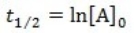
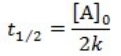
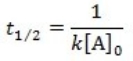
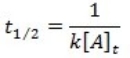
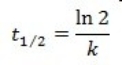
What is the half-life for a first-order reaction?


A) What is the half-life for a first-order reaction? A)    B)    C)    D)    E)
B) What is the half-life for a first-order reaction? A)    B)    C)    D)    E)
C) What is the half-life for a first-order reaction? A)    B)    C)    D)    E)
D) What is the half-life for a first-order reaction? A)    B)    C)    D)    E)
E) What is the half-life for a first-order reaction? A)    B)    C)    D)    E)

F) B) and D)
G) C) and E)

Correct Answer

verifed

verified

E

For the reaction 3A(g) + 2B(g) → 2C(g) + 2D(g) The following data were collected at constant temperature. Determine the correct rate law for this reaction. For the reaction 3A(g)  + 2B(g)  → 2C(g)  + 2D(g)  The following data were collected at constant temperature. Determine the correct rate law for this reaction.   A)  Rate = k[A][B] B)  Rate = k[A][B]<sup>2</sup> C)  Rate = k[A]<sup>3</sup>[B]<sup>2</sup> D)  Rate = k[A]<sup>1.5</sup>[B] E)  Rate = k[A]<sup>2</sup>[B]


A) Rate = k[A][B]
B) Rate = k[A][B]2
C) Rate = k[A]3[B]2
D) Rate = k[A]1.5[B]
E) Rate = k[A]2[B]

F) B) and C)
G) A) and B)

Correct Answer

verifed

verified

Which of the following is the correct unit for a second-order rate constant?


A) s-1
B) M • s-1
C) M • s
D) M -1 • s-1
E) M -2 • s-1

F) None of the above
G) A) and E)

Correct Answer

verifed

verified

Carbon-14 is a radioactive isotope which decays with a half-life of 5730 years. What is the first-order rate constant for its decay?


A) 5.25 × 10⁻⁵ yr-1
B) 1.21 × 10⁻⁴ yr-1
C) 1.75 × 10⁻⁴ yr-1
D) 3.49 × 10⁻⁴ yr-1
E) 3.97 × 10³ yr-1

F) A) and B)
G) C) and D)

Correct Answer

verifed

verified

The data below were determined for the reaction S2O82-(aq) + 3I-(aq) → 2SO42-(aq) + I3-(aq) . The data below were determined for the reaction S<sub>2</sub>O<sub>8</sub><sup>2-</sup>(aq)  + 3I<sup>-</sup>(aq)  → 2SO<sub>4</sub><sup>2-</sup>(aq)  + I<sub>3</sub><sup>-</sup>(aq) .   Which rate law is consistent with the experimental data for this reaction? A)  rate = k[S<sub>2</sub>O<sub>8</sub><sup>2- </sup>][I <sup>-</sup>]<sup>3</sup> B)  rate = k[S<sub>2</sub>O<sub>8</sub><sup>2-</sup>] C)  rate = k[S<sub>2</sub>O<sub>8</sub><sup>2-</sup>]<sup>2</sup>[I <sup>-</sup>]<sup>2</sup> D)  rate = k[I <sup>-</sup>] E)  rate = k[S<sub>2</sub>O<sub>8</sub><sup>2-</sup>][I <sup>-</sup>] Which rate law is consistent with the experimental data for this reaction?


A) rate = k[S2O82- ][I -]3
B) rate = k[S2O82-]
C) rate = k[S2O82-]2[I -]2
D) rate = k[I -]
E) rate = k[S2O82-][I -]

F) A) and B)
G) All of the above

Correct Answer

verifed

verified

Which is the correct unit for a zeroth-order rate constant?


A) s-1
B) M • s-1
C) M • s
D) M-1 • s-1
E) M-2 • s-1

F) B) and D)
G) A) and B)

Correct Answer

verifed

verified

B

The rate law for the rearrangement of CH3NC to CH3CN at 800 K is rate = (1300 s-1) [CH3NC]. What is the half-life for this reaction?


A) 7.69 × 10⁻⁴ s
B) 5.3 × 10⁻⁴ s
C) 1.9 × 10⁻³ s
D) 520 s
E) 1920 s

F) C) and D)
G) D) and E)

Correct Answer

verifed

verified

Cyclopropane is converted to propene in a first-order process. The rate constant is 5.4 × 10⁻² h-1. If the initial concentration of cyclopropane is 0.150 M, what will its concentration be after 22.0 hours?


A) 0.046 M
B) 0.11 M
C) 0.13 M
D) 0.49 M
E) 0.054 M

F) A) and B)
G) B) and D)

Correct Answer

verifed

verified

A

The reaction A + 2B → Products was found to have the rate law, rate = k[A][B]2. Predict by what factor the rate of reaction will increase when the concentration of A is doubled and the concentration of B is also doubled.


A) 2
B) 4
C) 6
D) 8
E) 9

F) D) and E)
G) A) and D)

Correct Answer

verifed

verified

For a zeroth-order reaction, if the concentration of reactant A is plotted vs. time, which corresponds to the slope of this plot?


A) 1/[A]
B) k
C) 1/k
D) ln[A]
E) -k

F) D) and E)
G) All of the above

Correct Answer

verifed

verified

Nitric oxide gas (NO) reacts with chlorine gas according to the equation NO + Nitric oxide gas (NO)  reacts with chlorine gas according to the equation NO +   Cl<sub>2 </sub>→ NOCl. The following initial rates of reaction have been measured for the given reagent concentrations.   Which of the following is the rate law for this reaction? A)  rate = k[NO] B)  rate = k[NO][Cl<sub>2</sub>]<sup>1/2</sup> C)  rate = k[NO][Cl<sub>2</sub>] D)  rate = k[NO]<sup>2</sup>[Cl<sub>2</sub>] E)  rate = k[NO]<sup>2</sup>[Cl<sub>2</sub>]<sup>2</sup> Cl2 → NOCl. The following initial rates of reaction have been measured for the given reagent concentrations. Nitric oxide gas (NO)  reacts with chlorine gas according to the equation NO +   Cl<sub>2 </sub>→ NOCl. The following initial rates of reaction have been measured for the given reagent concentrations.   Which of the following is the rate law for this reaction? A)  rate = k[NO] B)  rate = k[NO][Cl<sub>2</sub>]<sup>1/2</sup> C)  rate = k[NO][Cl<sub>2</sub>] D)  rate = k[NO]<sup>2</sup>[Cl<sub>2</sub>] E)  rate = k[NO]<sup>2</sup>[Cl<sub>2</sub>]<sup>2</sup> Which of the following is the rate law for this reaction?


A) rate = k[NO]
B) rate = k[NO][Cl2]1/2
C) rate = k[NO][Cl2]
D) rate = k[NO]2[Cl2]
E) rate = k[NO]2[Cl2]2

F) B) and E)
G) A) and B)

Correct Answer

verifed

verified

Consider the following potential energy profile for the A → B reaction. How many elementary steps are there? Consider the following potential energy profile for the A → B reaction. How many elementary steps are there?   A)  1 B)  2 C)  3 D)  4 E)  5


A) 1
B) 2
C) 3
D) 4
E) 5

F) A) and B)
G) None of the above

Correct Answer

verifed

verified

The elementary step of the reaction mechanism which only involves one reactant is called ________.

Correct Answer

verifed

verified

The oxidation of iodide ions by arsenic acid in acidic aqueous solution occurs according to the net reaction H3AsO4 + 3I - + 2H3O +→ H3AsO3 + I3- + 3H2O. The experimental rate law for this reaction is Rate = k [H3AsO4] [I-] [H3O+]. According to the rate law for the reaction, an increase in the concentration of hydronium ion has what effect on this reaction?

Correct Answer

verifed

verified

The rate o...

View Answer

The reaction A + 2B → Products was found to follow the rate law: rate = k[A]2[B]. Predict by what factor the rate of reaction will increase when the concentration of A is doubled, the concentration of B is tripled, and the temperature remains constant.


A) 5
B) 6
C) 12
D) 18
E) None of these

F) None of the above
G) A) and E)

Correct Answer

verifed

verified

A ________-________ is a reaction whose rate depends on the concentration of one of the reactants squared.

Correct Answer

verifed

verified

second-ord...

View Answer

In the collision theory of reaction rates, the rate constant for a bimolecular reaction can be written as k = A•exp(-Ea/RT) Briefly explain the physical meaning (interpretation) of the following factors which appear in the above expression: a. A b. exp(-Ea/RT)

Correct Answer

verifed

verified

a. the collision frequency or ...

View Answer

What are possible units for the rate of a reaction?


A) L • mol-1 • s-1
B) L2 • mol-2 • s-1
C) s-1
D) s-2
E) mol • L-1 • s-1

F) A) and E)
G) All of the above

Correct Answer

verifed

verified

Showing 1 - 20 of 132

Related Exams

Show Answer