Filters
Question type

Study Flashcards

Figure 21-15 On the graph, Qx represents the quantity of good x and Qy represents the quantity of good y. The lines drawn on the graph represent three of Barbara's indifference curves. Figure 21-15 On the graph, Q<sub>x</sub> represents the quantity of good x and Q<sub>y</sub> represents the quantity of good y. The lines drawn on the graph represent three of Barbara's indifference curves.   -Refer to Figure 21-15. Barbara is happier at A) point B than at point A. B) point B than at point C. C) point C than at point D. D) All of the above are correct. -Refer to Figure 21-15. Barbara is happier at


A) point B than at point A.
B) point B than at point C.
C) point C than at point D.
D) All of the above are correct.

E) A) and C)
F) None of the above

Correct Answer

verifed

verified

Scenario 21-2 Lawrence has recently graduated from college with a degree in journalism and economics. He has decided to pursue a career as a freelance journalist writing for business newspapers and magazines. Lawrence is typically awake for 112 hours each week (he sleeps an average of 8 hours each day) . For each hour Lawrence spends writing, he can earn $75. Lawrence is such a good writer that he can get paid for as many hours of writing as he chooses to work. -Refer to Scenario 21-2. If Lawrence's wage increases to $90 per hour of writing, which of the following points would fall on his budget constraint?


A) 75 hours of leisure, $2,775 of consumption
B) 80 hours of leisure, $2,400 of consumption
C) 85 hours of leisure, $2,430 of consumption
D) 90 hours of leisure, $1,650 of consumption

E) B) and D)
F) All of the above

Correct Answer

verifed

verified

Figure 21-24 The figure shows three indifference curves and a budget constraint for a certain consumer named Steve. Figure 21-24 The figure shows three indifference curves and a budget constraint for a certain consumer named Steve.   -Refer to Figure 21-24. About what percentage of his income is Steve spending on apples when he is at his optimum? A) 33.3 percent B) 38.2 percent C) 44.4 percent D) 56.7 percent -Refer to Figure 21-24. About what percentage of his income is Steve spending on apples when he is at his optimum?


A) 33.3 percent
B) 38.2 percent
C) 44.4 percent
D) 56.7 percent

E) B) and C)
F) A) and D)

Correct Answer

verifed

verified

Consider the indifference curve map and budget constraint for two goods, beef and potatoes. Suppose the good measured on the horizontal axis, potatoes, is a Giffen good. Beef is measured on the vertical axis and is a normal good. When the price of potatoes increases, the substitution effect causes


A) an increase in the consumption of potatoes, and the income effect causes a decrease in the consumption of potatoes. The substitution effect is less than the income effect.
B) a decrease in the consumption of potatoes, and the income effect causes an increase in the consumption of potatoes. The substitution effect is greater than the income effect.
C) an increase in the consumption of potatoes, and the income effect causes a decrease in the consumption of potatoes. The substitution effect is greater than the income effect.
D) a decrease in the consumption of potatoes, and the income effect causes an increase in the consumption of potatoes. The substitution effect is less than the income effect.

E) A) and B)
F) All of the above

Correct Answer

verifed

verified

Hannah and Chris each like jewelry and music by the Rolling Stones. If we were to graph an indifference curve with jewelry on the horizontal axis and CDs by the Rolling Stones on the vertical axis, then


A) Hannah and Chris would have identical indifference curves.
B) Hannah's indifference curve would be higher than Chris's indifference curve.
C) Chris's indifference curve would be higher than Hannah's indifference curve.
D) Because we do not know the intensity of each woman's preferences, we do not have enough information to compare their indifference curves.

E) None of the above
F) B) and C)

Correct Answer

verifed

verified

The slope of the budget constraint reveals the relative price of good X compared to good Y.

A) True
B) False

Correct Answer

verifed

verified

A consumer has preferences over consumption and leisure, both of which are normal goods. When the wage decreases, the consumer chooses to consume less leisure. For this consumer the labor supply curve will


A) slope upward.
B) slope backward.
C) be horizontal.
D) be vertical.

E) All of the above
F) A) and D)

Correct Answer

verifed

verified

Figure 21-19 Figure 21-19   -Refer to Figure 21-19. Assume that the consumer depicted in the figure has an income of $20. The price of Skittles is $2 and the price of M&M's is $2. The consumer's optimal choice is point A) A. B) B. C) C. D) D. -Refer to Figure 21-19. Assume that the consumer depicted in the figure has an income of $20. The price of Skittles is $2 and the price of M&M's is $2. The consumer's optimal choice is point


A) A.
B) B.
C) C.
D) D.

E) B) and D)
F) A) and B)

Correct Answer

verifed

verified

A good is an inferior good if the consumer buys less of it when


A) his income rises.
B) the price of the good rises.
C) the price of a substitute good falls.
D) his income falls.

E) All of the above
F) A) and C)

Correct Answer

verifed

verified

Economists have found evidence of a Giffen good when studying the consumption of rice in the Chinese province of Hunan.

A) True
B) False

Correct Answer

verifed

verified

Andi uses all of her income to purchase books and games. At any two points A and B on Andi's budget constraint,


A) Andi is spending all of her income on books and games.
B) Andi is spending one half of her income on books and the other half of her income on games.
C) the price of books relative to the price of games is different.
D) All of the above are correct.

E) B) and C)
F) A) and B)

Correct Answer

verifed

verified

Figure 21-28 The figure below illustrates the preferences for a representative consumer, Christopher. Figure 21-28 The figure below illustrates the preferences for a representative consumer, Christopher.   -Refer to Figure 21-28. Interest rates increase by 3 percent. Christopher's optimal choice point moves from A to B. Christopher consumes A) less while he is younger and saves more than he did before interest rates increased. B) more while he is younger and saves more than he did before interest rates increased. C) less while he is younger and saves less than he did before interest rates increased. D) more while he is younger and saves less than he did before interest rates increased. -Refer to Figure 21-28. Interest rates increase by 3 percent. Christopher's optimal choice point moves from A to B. Christopher consumes


A) less while he is younger and saves more than he did before interest rates increased.
B) more while he is younger and saves more than he did before interest rates increased.
C) less while he is younger and saves less than he did before interest rates increased.
D) more while he is younger and saves less than he did before interest rates increased.

E) A) and B)
F) A) and C)

Correct Answer

verifed

verified

A consumer's budget constraint is drawn on a graph with the number of sandwiches measured along the horizontal axis and the number of bowls of soup measured along the vertical axis. Hold the consumer's income and the price of a sandwich fixed, and increase the price of a bowl of soup. Describe the effect on the budget constraint.

Correct Answer

verifed

verified

The horizontal intercept is un...

View Answer

If the relative price of a concert ticket is three times the price of a meal at a good restaurant, then the opportunity cost of a concert ticket can be measured by the


A) slope of the budget constraint.
B) slope of an indifference curve.
C) marginal rate of substitution.
D) income effect.

E) A) and B)
F) A) and C)

Correct Answer

verifed

verified

Suppose good X is on the horizontal axis, good Y is on the vertical axis, and the slope of an individual's budget line is -2. Which of the following is true?​


A) ​Good Y is twice as expensive as good X.
B) ​The consumer gives up two units of good Y for each unit of good X she purchases.
C) ​The opportunity cost of good X is one half of a unit of good Y.
D) ​All of the above are correct.

E) A) and D)
F) B) and C)

Correct Answer

verifed

verified

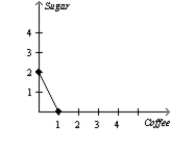
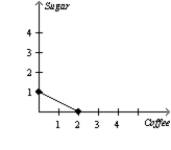
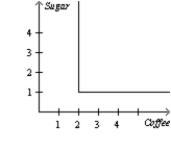
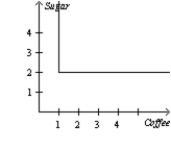
Suppose Caroline will only drink a cup of coffee if she can add two packets of sugar to it. Which graph would illustrate a representative indifference curve?


A) Suppose Caroline will only drink a cup of coffee if she can add two packets of sugar to it. Which graph would illustrate a representative indifference curve? A)    B)    C)    D)
B) Suppose Caroline will only drink a cup of coffee if she can add two packets of sugar to it. Which graph would illustrate a representative indifference curve? A)    B)    C)    D)
C) Suppose Caroline will only drink a cup of coffee if she can add two packets of sugar to it. Which graph would illustrate a representative indifference curve? A)    B)    C)    D)
D) Suppose Caroline will only drink a cup of coffee if she can add two packets of sugar to it. Which graph would illustrate a representative indifference curve? A)    B)    C)    D)

E) All of the above
F) C) and D)

Correct Answer

verifed

verified

An optimizing consumer will select the consumption bundle in which the


A) ratio of total utilities is equal to the relative price ratio.
B) ratio of income to price equals the marginal rate of substitution.
C) marginal rate of substitution is equal to the relative price ratio of the goods.
D) marginal rate of substitution is equal to marginal utility.

E) A) and D)
F) All of the above

Correct Answer

verifed

verified

Clark enjoys fishing and hunting. He divides his leisure hours between the two outdoor activities. Suppose we were to draw Clark's indifference curves for the two activities, placing fishing on the horizontal axis and hunting on the vertical axis. If Clark's indifference curves are bowed inward, then


A) the rate at which he is willing to give up an hour of hunting for an hour of fishing changes depending on how many hours of each activity he has done. For example, if Clark has already fished a lot in one week, he will be more willing to give up an hour of fishing for an hour of hunting than if he has only fished a little that week.
B) the rate at which he is willing to give up an hour of hunting for an hour of fishing is constant because he must derive the same enjoyment out of each activity.
C) the rate at which he is willing to give up an hour of hunting for an hour of fishing changes depending on how many hours of each activity he has done. For example, if Clark has already fished a lot in one week, he will be less willing to give up an hour of fishing for an hour of hunting than if he has only fished a little that week.
D) Clark's indifference curves will not cross. When indifference curves are bowed outward, the indifference curves must cross.

E) B) and C)
F) A) and B)

Correct Answer

verifed

verified

Figure 21-32 The figure shows three indifference curves and a budget constraint for a consumer named Hannah. When young, Hannah works and earns income. When old, she is retired and earns no income. Figure 21-32 The figure shows three indifference curves and a budget constraint for a consumer named Hannah. When young, Hannah works and earns income. When old, she is retired and earns no income.   -Refer to Figure 21-32. Which of the four labeled points is Hannah's optimum? -Refer to Figure 21-32. Which of the four labeled points is Hannah's optimum?

Correct Answer

verifed

verified

Point B is...

View Answer

Evaluate the following statement, "Warren Buffet is the second richest person in the world. He doesn't face any constraint on his ability to purchase commodities he wants."

Correct Answer

verifed

verified

All people face scarcity of re...

View Answer

Showing 121 - 140 of 568

Related Exams

Show Answer