Filters
Question type

Study Flashcards

Table 7-3 The only four consumers in a market have the following willingness to pay for a good: Table 7-3 The only four consumers in a market have the following willingness to pay for a good:   -Refer to Table 7-3. If there is only one unit of the good and if the buyers bid against each other for the right to purchase it, then the consumer surplus will be A) $0 or slightly more. B) $10 or slightly less. C) $30 or slightly more. D) $45 or slightly less. -Refer to Table 7-3. If there is only one unit of the good and if the buyers bid against each other for the right to purchase it, then the consumer surplus will be


A) $0 or slightly more.
B) $10 or slightly less.
C) $30 or slightly more.
D) $45 or slightly less.

E) None of the above
F) B) and C)

Correct Answer

verifed

verified

A seller's opportunity cost measures the


A) value of everything she must give up to produce a good.
B) amount she is paid for a good minus her cost of providing it.
C) consumer surplus.
D) out of pocket expenses to produce a good but not the value of her time.

E) A) and B)
F) A) and C)

Correct Answer

verifed

verified

Figure 7-19 Figure 7-19   -Refer to Figure 7-19. At the equilibrium price, producer surplus is A) $300. B) $150. C) $450. D) $125. -Refer to Figure 7-19. At the equilibrium price, producer surplus is


A) $300.
B) $150.
C) $450.
D) $125.

E) A) and B)
F) A) and C)

Correct Answer

verifed

verified

You are offered a free ticket to see the Chicago Cubs play the Chicago White Sox at Wrigley Field. Assume the ticket has no resale value. Willie Nelson is performing on the same night, and his concert is your next-best alternative activity. Tickets to see Willie Nelson cost $40. On any given day, you would be willing to pay up to $50 to see and hear Willie Nelson perform. Assume there are no other costs of seeing either event. Based on this information, at a minimum, how much would you have to value seeing the Cubs play the White Sox to accept the ticket and go to the game?


A) $0
B) $10
C) $40
D) $50

E) A) and D)
F) A) and C)

Correct Answer

verifed

verified

Figure 7-10 Figure 7-10   -Refer to Figure 7-10. Which area represents producer surplus when the price is P2? A) BCG B) ACH C) ABGD D) AHGB -Refer to Figure 7-10. Which area represents producer surplus when the price is P2?


A) BCG
B) ACH
C) ABGD
D) AHGB

E) A) and B)
F) A) and C)

Correct Answer

verifed

verified

If a market is in equilibrium, then it is impossible for a social planner to raise economic welfare by increasing or decreasing the quantity of the good.

A) True
B) False

Correct Answer

verifed

verified

Table 7-1 Table 7-1   -Refer to Table 7-1. If price of the product is $135, then the total consumer surplus is A) $-50. B) $-35. C) $15. D) $150. -Refer to Table 7-1. If price of the product is $135, then the total consumer surplus is


A) $-50.
B) $-35.
C) $15.
D) $150.

E) C) and D)
F) B) and D)

Correct Answer

verifed

verified

Figure 7-3 Figure 7-3   -Refer to Figure 7-3. Area C represents the A) decrease in consumer surplus that results from a downward-sloping demand curve. B) consumer surplus to new consumers who enter the market when the price falls from P2 to P1. C) increase in producer surplus when quantity sold increases from Q2 to Q1. D) decrease in consumer surplus to each consumer in the market when the price increases from P1 to P2. -Refer to Figure 7-3. Area C represents the


A) decrease in consumer surplus that results from a downward-sloping demand curve.
B) consumer surplus to new consumers who enter the market when the price falls from P2 to P1.
C) increase in producer surplus when quantity sold increases from Q2 to Q1.
D) decrease in consumer surplus to each consumer in the market when the price increases from P1 to P2.

E) C) and D)
F) None of the above

Correct Answer

verifed

verified

Which of the Ten Principles of Economics does welfare economics explain more fully?


A) The cost of something is what you give up to get it.
B) Markets are usually a good way to organize economic activity.
C) Trade can make everyone better off.
D) A country's standard of living depends on its ability to produce goods and services.

E) A) and C)
F) A) and B)

Correct Answer

verifed

verified

Figure 7-6 Figure 7-6   -Refer to Figure 7-6. At the equilibrium price, consumer surplus is A) $1,600. B) $800. C) $1,400. D) $700. -Refer to Figure 7-6. At the equilibrium price, consumer surplus is


A) $1,600.
B) $800.
C) $1,400.
D) $700.

E) A) and B)
F) A) and C)

Correct Answer

verifed

verified

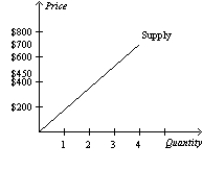
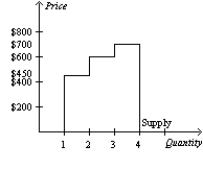
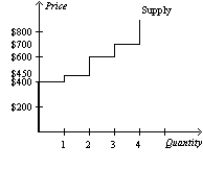
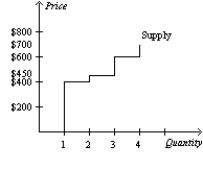
Table 7-14 Table 7-14   -Refer to Table 7-14. You want to hire a professional photographer to take pictures of your family. The table shows the costs of the four potential sellers in the local photography market. Which of the following graphs represents the market supply curve? A)    B)    C)    D)   -Refer to Table 7-14. You want to hire a professional photographer to take pictures of your family. The table shows the costs of the four potential sellers in the local photography market. Which of the following graphs represents the market supply curve?


A) Table 7-14   -Refer to Table 7-14. You want to hire a professional photographer to take pictures of your family. The table shows the costs of the four potential sellers in the local photography market. Which of the following graphs represents the market supply curve? A)    B)    C)    D)
B) Table 7-14   -Refer to Table 7-14. You want to hire a professional photographer to take pictures of your family. The table shows the costs of the four potential sellers in the local photography market. Which of the following graphs represents the market supply curve? A)    B)    C)    D)
C) Table 7-14   -Refer to Table 7-14. You want to hire a professional photographer to take pictures of your family. The table shows the costs of the four potential sellers in the local photography market. Which of the following graphs represents the market supply curve? A)    B)    C)    D)
D) Table 7-14   -Refer to Table 7-14. You want to hire a professional photographer to take pictures of your family. The table shows the costs of the four potential sellers in the local photography market. Which of the following graphs represents the market supply curve? A)    B)    C)    D)

E) None of the above
F) All of the above

Correct Answer

verifed

verified

If the government imposes a binding price floor in a market, then the consumer surplus in that market will increase.

A) True
B) False

Correct Answer

verifed

verified

Which of the following is not equal to total surplus?


A) consumer surplus - producer surplus
B) buyers' willingness to pay - sellers' costs
C) value to buyers - amount paid by buyers + amount received by sellers - cost to sellers
D) value to buyers - cost to sellers

E) A) and D)
F) All of the above

Correct Answer

verifed

verified

Welfare economics is the study of the welfare system.

A) True
B) False

Correct Answer

verifed

verified

If Martin sells a shirt for $40, and his producer surplus from the sale is $8, his cost must have been


A) $48.
B) $32.
C) $8.
D) $40.

E) B) and C)
F) B) and D)

Correct Answer

verifed

verified

Figure 7-9 Figure 7-9   -Refer to Figure 7-9. If producer surplus is $19, then the price of the good is A) $11.50. B) $14.50. C) $13.50. D) $9.75. -Refer to Figure 7-9. If producer surplus is $19, then the price of the good is


A) $11.50.
B) $14.50.
C) $13.50.
D) $9.75.

E) None of the above
F) B) and D)

Correct Answer

verifed

verified

Table 7-10 The following table represents the costs of five possible sellers. Table 7-10 The following table represents the costs of five possible sellers.   -Refer to Table 7-10. If the market price is $1,100, the combined total cost of all participating sellers is A) $2,800. B) $2,900. C) $1,700. D) $4,000. -Refer to Table 7-10. If the market price is $1,100, the combined total cost of all participating sellers is


A) $2,800.
B) $2,900.
C) $1,700.
D) $4,000.

E) B) and C)
F) A) and B)

Correct Answer

verifed

verified

Consumer surplus in a market can be represented by the


A) area below the demand curve and above the price.
B) distance from the demand curve to the horizontal axis.
C) distance from the demand curve to the vertical axis.
D) area below the demand curve and above the horizontal axis.

E) B) and C)
F) A) and B)

Correct Answer

verifed

verified

Figure 7-15 Figure 7-15   -Refer to Figure 7-15. When the price falls from P2 to P1, which of the following would not be true? A) The sellers who still sell the good are worse off because they now receive less. B) Some sellers leave the market because they are not willing to sell the good at the lower price. C) The total cost of what is now sold by sellers is actually higher than it was before the decrease in the price. D) Producer surplus would fall by area A + B. -Refer to Figure 7-15. When the price falls from P2 to P1, which of the following would not be true?


A) The sellers who still sell the good are worse off because they now receive less.
B) Some sellers leave the market because they are not willing to sell the good at the lower price.
C) The total cost of what is now sold by sellers is actually higher than it was before the decrease in the price.
D) Producer surplus would fall by area A + B.

E) C) and D)
F) None of the above

Correct Answer

verifed

verified

Figure 7-34 Figure 7-34   -Refer to Figure 7-34. Suppose the government imposes a price floor at $10 per unit in this market. With the price floor, how much is total consumer surplus? -Refer to Figure 7-34. Suppose the government imposes a price floor at $10 per unit in this market. With the price floor, how much is total consumer surplus?

Correct Answer

verifed

verified

Total consumer surpl...

View Answer

Showing 461 - 480 of 547

Related Exams

Show Answer